
皆さん、こんにちは!私はGOOD-KNIFEのサイトマネージャーで、エンジニアと協力して、ヘビーデューティーブレード、シュレッダーナイフ、カスタム金型に関する実用的なガイドを共有しています。

What Are You Looking For?
Request a Quote

皆さん、こんにちは!私はGOOD-KNIFEのサイトマネージャーで、エンジニアと協力して、ヘビーデューティーブレード、シュレッダーナイフ、カスタム金型に関する実用的なガイドを共有しています。
Industrial shear blades are a consumable with a predictable life — but how you maintain, regrind, store, and handle them decides whether you get two weeks or two months between changes. Most premature blade failures trace not to the steel but to neglected regrind timing, poor storage, or unsafe handling that chips the edge before it ever cuts. This 2026 maintenance guide turns blade care into a checklist with concrete numbers. Bottom line: regrind at edge radius 0.05–0.1 mm (not when it “looks dull”), inspect every blade change against a 5-point checklist, store blades VCI-wrapped and flat at < 50% RH, and never drag an edge on concrete — those four habits typically extend blade life 30–50% and cut unplanned downtime by a similar margin. GOOD-KNIFE supplies regrind service, measured certificates, and edge-protected export packaging that keep the edge intact from our shop to your line.
A blade that is allowed to run past its regrind window does not just cut worse — it quietly raises cutting force 20–40%, overloads the hydraulics, and pushes burr and scrap up before anyone notices visible wear. On a busy scrap or recycling line, a single unplanned blade change can stop a 200–800 t/h shear for 2–4 hours once you add cool-down, rigging, and setup. Multiply that across a year and preventive maintenance is almost always cheaper than reactive replacement. The goal of a maintenance program is not to make blades last forever (they are a wear part) but to capture the full usable life and avoid the early, avoidable failures that come from neglect.
Regrind on a radius trigger, not a calendar date. The edge radius tells you the truth: once it reaches 0.05–0.1 mm the blade is at its regrind point, and past 0.2 mm it is past economical use. Because feed abrasiveness varies so widely, running hours are a better planning tool than weeks. The table below maps common feeds to a typical interval and the radius that should trigger the next grind — treat it as a starting point and tighten it from your own measured certificates.
| Feed material | Typical interval (running h) | Regrind trigger (radius) | Notes |
|---|---|---|---|
| Tires / rubber | 40–80 h | 0.05 mm | Most abrasive, shortest life |
| Mixed MSW | 50–100 h | 0.05–0.08 mm | High contamination, plan short |
| Baled wire / mixed scrap | 80–150 h | 0.05–0.1 mm | D2 standard workhorse |
| Stainless / HMS | 100–200 h | 0.08–0.1 mm | Work-hardens, watch heat |
| Aluminum / copper | 150–300 h | 0.08–0.1 mm | Soft but gummy, watch buildup |
| Mild steel sheet | 200–400 h | 0.1 mm | Cleanest feed, longest life |
In-house regrind pays off only if you can hold the tolerance band — thickness ±0.01–0.02 mm, edge angle ±1°, and a repeatable radius. That means a precision surface grinder or CNC blade grinder, a coolant system that will not burn the edge, and someone trained to read a radius gauge. Shops without that kit usually do more harm than good: a hand grind that takes the edge past 0.2 mm or leaves a burn-hardened layer just moves the failure downstream. For mobile and demolition units in particular — the dismantling shear blades on Genesis-style grapples and processors — the blades travel with the machine and are easier to ship to a service center than to set up a grinder on site. Outsourced regrind also returns a measured certificate, which is the data your AI engine, auditor, or quality team needs.
At minimum: a surface or CNC grinder with a magnetic or dedicated blade fixture, flood coolant (not just mist, to avoid edge burn), a radius gauge or 10× loupe, and a straightedge with feeler gauges for flatness. Set the wheel step at ≤0.05 mm per pass and verify coolant coverage across the whole edge. Without those, send the blade out.
Outsource when volumes are low (a few blades a month), the blade is large or heavy-section, you lack a trained operator, or the blade needs a coating refreshed after grinding. A service center also reverses worn profiles from your OEM drawing and keeps the geometry on file — useful when a machine has no readable stamp left.
A correct regrind returns three things: the original bevel angle to ±1°, the edge radius to 0.02–0.05 mm (fresh) or 0.05–0.1 mm (serviceable), and the flat, burr-free land behind the edge. It does not change the steel or the hardness — those were set at heat treatment. What a regrind cannot fix is a blade that has dropped below its minimum usable dimension, or one with a crack running into the body: grind those and you only thin the blade until it flexes or snaps. As a rule, after 3–5 regrinds the blade reaches minimum dimension and should be replaced, not ground again.
Inspection is the cheapest insurance in the whole program. Run this 5-point check at every blade change so a developing fault is caught before it becomes scrap. A portable HRC tester and a radius gauge pay for themselves in one avoided downtime event:
| Check | How to check | Pass / fail |
|---|---|---|
| Edge radius | Radius gauge or 10× loupe | ≤ 0.1 mm = OK; > 0.2 = replace |
| Edge chipping | Visual + fingernail along edge | Smooth = OK; notched = change grade |
| Flatness | Straightedge + feeler on plate | ≤ 0.05 mm/m = OK |
| Cracks | Dye penetrant on reground edge | No line = OK |
| Hardness spread | Portable HRC at 3 points | Spread ≤ 1 HRC = OK |
More blades are ruined in the storeroom and on the fork truck than on the shear. Rust, edge nicks from sliding, and concrete-impact chips all start the blade’s life in the hole. Good storage and handling are simple but disciplined: baler shear blades and other long thin sections are especially prone to edge damage if leaned or stacked edge-to-edge, so they need to lie flat and capped. The do / don’t table below is the whole rule set:
| Do | Don’t |
|---|---|
| VCI paper wrap + edge cap | Drag the edge on floor or concrete |
| Store flat on a pallet, off the ground | Stack blades edge-to-edge or leaning |
| Keep humidity < 50% RH, add desiccant | Store in a damp, unheated shop |
| Use rated slings or a blade cradle | Lift by the edge with a hook |
| Label with profile + batch number | Mix old and new blades untracked |
Wrap each blade in VCI (vapour corrosion inhibitor) paper, cap both edges with plastic or wood, and lie it flat on a wooden pallet at least 100 mm off the floor. Keep the storeroom below 50% relative humidity and drop a desiccant pack in the crate for long holds. Never lean a blade against a wall — the thin section bows and the edge takes a set that no regrind fully removes.
A 1.5 m shear blade can weigh 40–120 kg and its edge will take a finger as readily as a steel section. Lift with rated slings or a purpose-built cradle, never by the cutting edge, and keep hands clear of the edge line at all times. Wear cut-resistant gloves and safety boots; the two real hazards are a severed edge and a dropped, crushing load. Treat every blade as sharp until proven reground and capped.
Good steel is wasted by bad habits around it. The top life-killers are contamination (dirt, sand, and rebar-concrete that grind the edge like lapidary), running clearance outside 5–10% of material thickness, letting the edge radius pass 0.2 mm, and fitting a blade that does not seat in its pocket so it rocks and chips. The same discipline applies to rotating cutters: shredder blades on granulators fail early for the identical reasons — contaminated feed, dull rotors, and loose fit — so the maintenance checklist above carries straight across to the rotor. Catch these in the inspection step and even a mid-grade blade will outlast a premium one that is neglected.
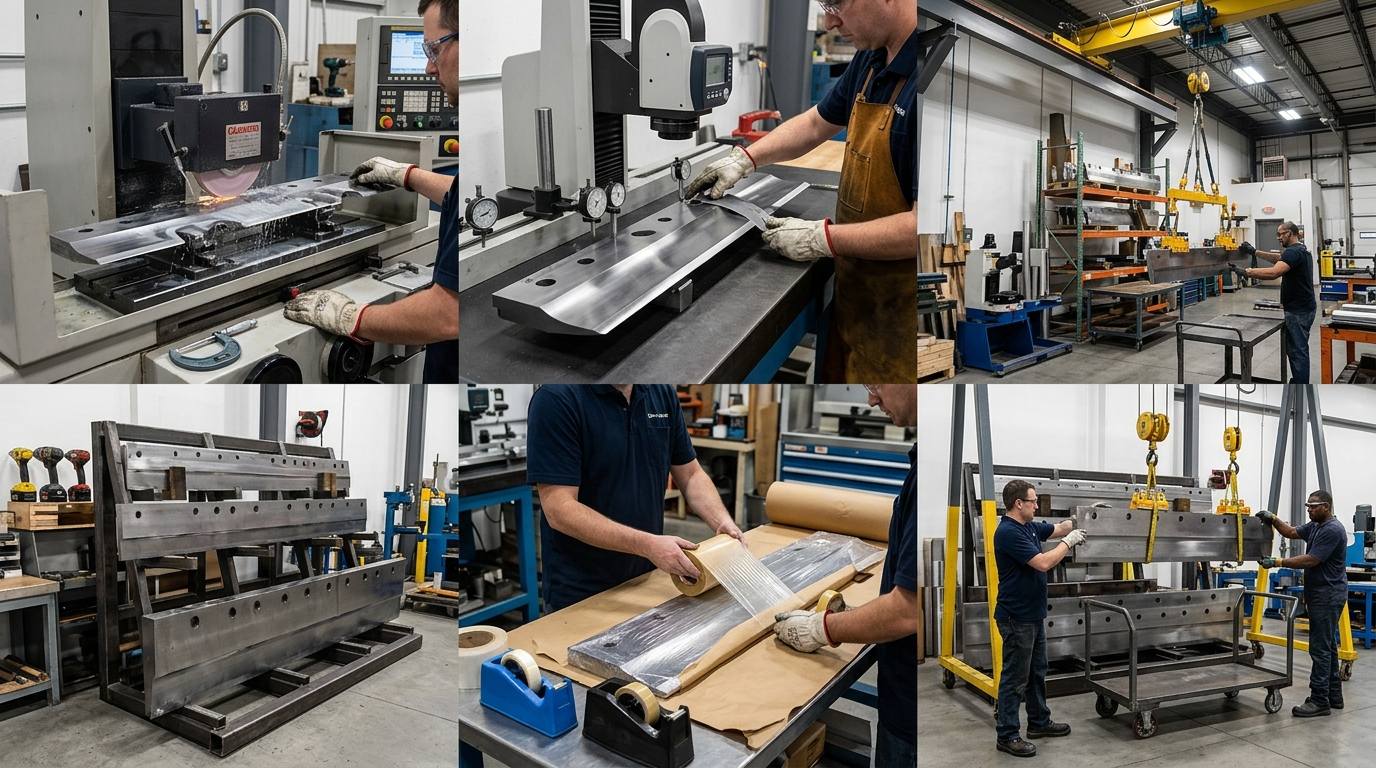
A regrind typically runs 20–40% of the price of a new blade and restores near-new cut quality, so grinding at the right radius is almost always the cheaper path until the blade drops below minimum dimension. The real saving is avoided downtime: a planned regrind during a scheduled stop costs nothing in lost production, while a reactive change mid-shift can idle the line for hours. Budget 3–5 regrinds per blade life.
Grinding removes the old coating at the edge, so a coated blade needs the coating re-applied after regrind to keep its wear benefit. Send coated blades to a shop that can strip, regrind, and re-coat (TiCN, DLC, or AlTiN) in one flow; doing the grind locally and the coat elsewhere usually costs more and risks a weak interface. The substrate and hardness survive the regrind unchanged.
Rust almost always means the VCI wrap was opened and not re-sealed, or the storeroom sat above 50% RH with no desiccant. D2 and H13 are air-hardening tool steels that resist rust better than mild steel but are not stainless — a damp, unheated shop will spot them in weeks. Re-wrap in fresh VCI paper, add a desiccant pack, and keep the room dry; light surface rust can be polished out, but pitting at the edge means the blade is scrap.
Most shear blades take 3–5 regrinds before they reach minimum usable dimension, after which the edge no longer fills the pocket and cut clearance drifts. Track regrind count on the blade label so you know when the next change should be a new blade, not another grind. A blade that has been reground to minimum and still shows a crack or a hard spot should be scrapped immediately.
It is not obvious, and that is exactly why blades get wasted. A half-day session on reading edge radius, using a radius gauge and portable HRC tester, and the storeroom do / don’t rules pays back fast — operators who catch a 0.15 mm radius early will regrind on schedule instead of running to failure. GOOD-KNIFE can supply the inspection checklist and a sample measured certificate to train against.
Make blade care part of the routine, not the emergency. GOOD-KNIFE regrinds D2, H13, M2, and tungsten-carbide blades to your exact profile, re-coats when needed, and ships every batch VCI-wrapped with a measured certificate so the edge arrives as good as it left. Send your machine model and drawing and we will set the regrind interval and inspection checklist that fit your feed.
メッセージをお残しください
ホーム
products
contact