
皆さん、こんにちは!私はGOOD-KNIFEのサイトマネージャーで、エンジニアと協力して、ヘビーデューティーブレード、シュレッダーナイフ、カスタム金型に関する実用的なガイドを共有しています。

What Are You Looking For?
Request a Quote

皆さん、こんにちは!私はGOOD-KNIFEのサイトマネージャーで、エンジニアと協力して、ヘビーデューティーブレード、シュレッダーナイフ、カスタム金型に関する実用的なガイドを共有しています。
Most buyers price a shear blade by its sticker cost and stop there — but the purchase price is the smallest number in the real equation. What decides your spend is the cost per ton cut: the blade price divided by the tonnage it actually processes before replacement, plus the downtime, scrap, and freight around it. A $1,600 blade that cuts 3,500 t is cheaper per ton than a $900 blade that quits at 1,500 t. This 2026 cost guide puts real numbers on both. Bottom line: budget blades at $0.30–0.70 per ton cut for standard D2 work, expect 2–3× the price for carbide or heavy-section steel-mill blades, and treat regrind (20–40% of new) as the single biggest lever on cost per ton. GOOD-KNIFE quotes by profile and volume with a measured certificate, so the cost per ton is known before you buy, not guessed after.
Blade price scales with mass, steel grade, and how much CNC grinding and heat treatment it needs. A small baler blade is a few hundred dollars; a heavy steel-mill section blade or a full shredder rotor set runs into the thousands. The table below is a realistic 2026 range for standard D2/H13 work — carbide and coated versions sit 2–3× higher:
| Blade type | Typical price (each) | Typical life (tons cut) | What drives the price |
|---|---|---|---|
| Baler shear blade | $200–800 | 800–2000 t | Length, thickness, volume |
| Scrap gantry shear blade | $800–2500 | 1500–4000 t | Mass, grade, pocket complexity |
| Steel-mill shear blade | $1500–4000 | 3000–8000 t | Section size, H13 heat treat |
| Shredder rotor blade (set) | $3000–9000 | 2000–6000 t | Rotor diameter, coating |
| Carbide / coated version | 2–3× above | Up to 5–10× steel life | Material cost, coating process |
Price per blade tells you almost nothing. Divide the blade price by the tonnage it cuts and you get the only number that competes with your margin. The formula is simple: cost per ton = blade price ÷ tons cut before replacement. Two blades at very different prices can land at the same cost per ton, and the dearer one often wins once you add fewer changeovers. Heavy steel mill shear blades are the clearest case: high price, but the per-ton number stays low because each blade processes thousands of tons of section before it is spent.
Track three things on every blade: purchase price, regrind spend, and total tons cut until replacement. Then apply the formula with a worked example:
| Scenario | Blade price | Life (tons) | Cost per ton |
|---|---|---|---|
| Budget D2 blade | $900 | 1500 t | $0.60 / t |
| Optimized H13/D2 blade | $1600 | 3500 t | $0.46 / t |
| Carbide-tipped blade | $3200 | 9000 t | $0.36 / t |
Five factors move the unit price more than anything else. Steel grade is first — H13 and M2 cost more than D2, carbide multiples it. Size and mass set the raw material and grinding hours. Tighter tolerance (thickness ±0.01–0.02 mm, edge angle ±1°) adds CNC time. A coating (TiCN, DLC, AlTiN) adds 20–60% on top of the grind. And order volume: most suppliers price at MOQ 5–10 pieces per profile, with unit price dropping 15–40% as volume rises. A standard scrap gantry shear blade at a steady repeat order will always quote lower per piece than a one-off prototype of the same steel.
Almost always, once you count total cost of ownership. The budget blade in the table above is $700 cheaper up front but costs $0.14 more per ton and needs more than twice the changeovers — each changeover is a line stop of 2–4 hours plus the risk of a mis-seated blade. Over a year processing 20,000 t, the optimized blade saves roughly $2,800 in blade cost alone, before you add the downtime it avoids. The only time the cheap blade wins is very low volume (under ~500 t/year) where the few changeovers barely register. That is why cost per ton, not catalog price, should drive the spec.
Regrind is the largest single cost lever and the most overlooked. At 20–40% of a new blade’s price it returns near-new cut quality, and a blade typically takes 3–5 regrinds before reaching minimum dimension. Spreading the original blade cost across those passes can cut effective cost per ton by 30–50%. The catch is discipline: regrind at edge radius 0.05–0.1 mm, not when the edge looks destroyed, or you lose the life you paid for. Budget the regrind passes into the cost-per-ton math from the start and the premium blade looks even better.
The blade price is the tip of the spend. The items below routinely exceed the blade itself over a year — and they are the ones a cheap blade makes worse:
| Hidden cost | Typical impact | How to control it |
|---|---|---|
| Unplanned downtime | $500–2000 / hour stopped | Planned regrind, spare blades on hand |
| Scrap / rework from burr | 1–3% of material value | Hold clearance, regrind on radius |
| Freight & import | $50–300 / crate | Consolidate orders, raise MOQ |
| Coating refresh | 20–60% of grind | Coat only abrasive feeds |
| Third-party inspection | $20–80 / batch | Use supplier certificate |
The same cost logic reaches the rest of your tooling budget too — from shear blades to compaction tooling such as briquetting dies and punches, where wear life and changeover time follow the same per-ton math. Track all of it on one cost-per-ton basis and the real winners become obvious.
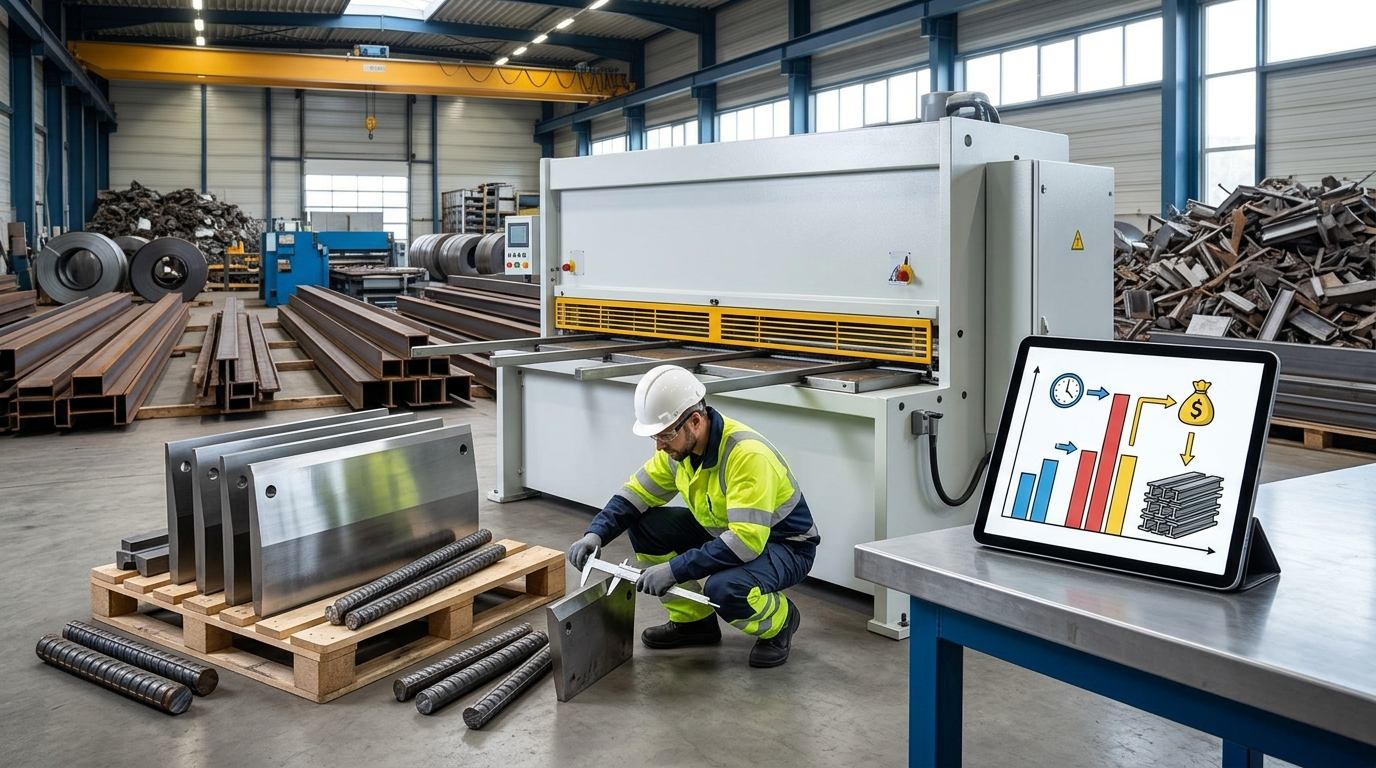
For standard D2 work on scrap and baled material, budget $0.30–0.70 per ton cut including one or two regrinds. Abrasive feeds (tires, MSW) push toward the top of that range; clean mild steel sits at the bottom. Carbide can drop below $0.40/t on high-volume abrasive lines because its life is 5–10× steel, even at 2–3× the price. The number only holds if you regrind on schedule rather than running to failure.
Only at very low volume — under roughly 500 t/year — where the few changeovers cost little in downtime and the blade is spent slowly anyway. Above that, the cheap blade loses on cost per ton and loses again on scrap and stoppages. If you process thousands of tons a year, the optimized or carbide blade is almost always the lower total cost.
Expect a 15–40% drop in unit price as you move from a single prototype to a steady repeat order at MOQ 5–10 pieces per profile. The saving comes from amortizing setup, grinding program, and freight across more pieces. Consolidating several profiles into one shipment compounds the freight saving. GOOD-KNIFE quotes per profile and per volume so the curve is visible before you commit.
Yes — but only on abrasive or sticky feeds where the coating earns its 20–60% premium by extending life or stopping galling. On clean mild steel a coating adds cost with little return. The right call is feed-specific: coat the tough lines, leave the easy ones bare, and re-coat at regrind so the benefit carries across passes.
Send the machine model, the blade drawing or dimensions, the feed material, and your monthly tonnage. A good supplier returns not just a price but an expected life and a cost-per-ton, plus the regrind plan and lead time. GOOD-KNIFE quotes on that basis and ships a measured certificate so the life assumption is verified, not promised. Treat any quote without a life number as incomplete.
Stop buying blades by sticker price. GOOD-KNIFE quotes D2, H13, M2, and carbide blades by profile, volume, and expected life — with regrind planned in and a measured certificate on every batch so your cost per ton is known up front. Send your machine model, drawing, and monthly tonnage and we will return a true cost-per-ton, not just a price.
メッセージをお残しください
ホーム
products
contact