
皆さん、こんにちは!私はGOOD-KNIFEのサイトマネージャーで、エンジニアと協力して、ヘビーデューティーブレード、シュレッダーナイフ、カスタム金型に関する実用的なガイドを共有しています。

What Are You Looking For?
Request a Quote

皆さん、こんにちは!私はGOOD-KNIFEのサイトマネージャーで、エンジニアと協力して、ヘビーデューティーブレード、シュレッダーナイフ、カスタム金型に関する実用的なガイドを共有しています。
Ask an operator why a shredder blade failed early and the answer is almost always the same: the steel was not hard enough. In practice, hardness explains only part of what happens inside a shredding chamber. Metal shredding is not a single event called "cutting." It is a sequence of stress concentration, crack initiation, separation, and material flow - and the result depends on edge geometry, clearance, load path, blade material, and heat treatment acting together.
This guide looks at industrial shredder blades from the cutting mechanism upward. Rather than comparing blade types, it explains what actually happens between the edge and the scrap, why the same blade can perform well on one line and fail on another, and which measurable parameters decide whether you shear material cleanly or rub it into heat, noise, and fines.
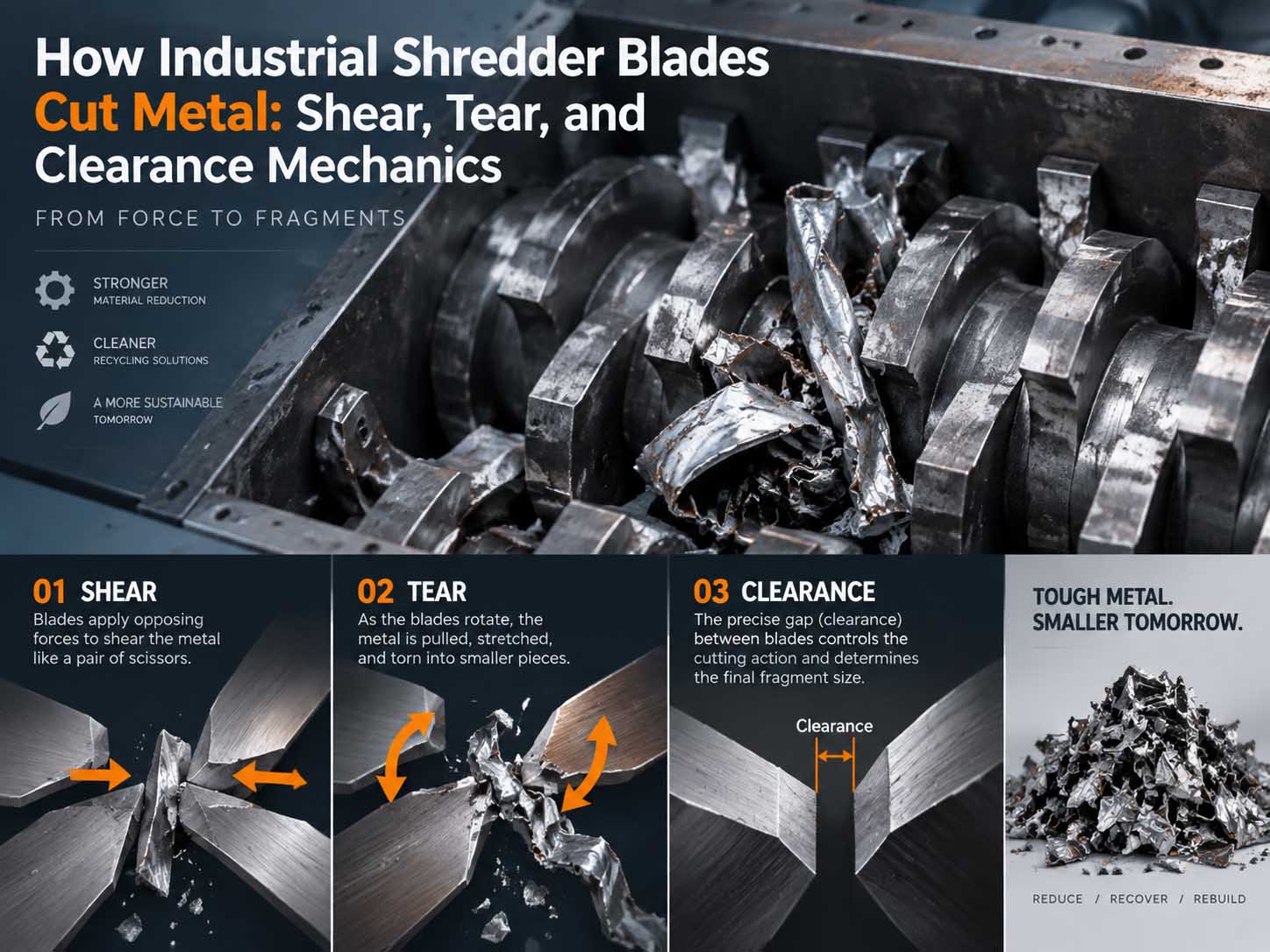
Industrial shredding is not machining. There is no continuous chip curling away from a controlled cut. Instead, the edge penetrates the material, concentrates stress into a very small area, and initiates a crack. Once that crack starts, material separates along the weakest path available - and the blade only guides where that path runs.
Two parameters dominate this moment. The first is edge radius: how sharp the edge actually is at the tip. The second is edge angle: how much material supports the tip behind it. A sharp, thin edge penetrates with less force, so more of the drive power goes into separating material. As the edge rounds, the same blade stops shearing and starts compressing. Force requirements rise, the material deforms instead of fracturing, and the energy that no longer separates metal turns into friction heat, noise, and vibration.
This is why a dull blade is not simply a slower blade. It is a different machine. The cutting action changes, the load on the drive changes, and the wear rate on every downstream component changes with it.
Most shredding chambers produce all three actions at once, but one usually dominates. Which one dominates should be a deliberate choice, because each demands different blade properties.
Shear happens when two edges pass each other with a controlled gap and the crack propagates ahead of the moving edge. It produces the cleanest fracture, the most consistent particle size, and the lowest energy per ton. Sheet metal offcuts, profiles, aluminium sections, cable, and pressed bales respond well to shear-dominated cutting.
Tear happens when material is grabbed, pulled, and ripped apart by intermeshing hooks and rotors. Tear-dominated shredding tolerates unpredictable feed, which is why auto shredding of end-of-life vehicles and mixed light iron relies on it. The trade-off is severe impact loading: the blade must absorb shock without chipping, so toughness matters more than maximum hardness.
Crush is what happens when neither shear nor tear is achieved properly. Material is bent, compressed, and squeezed until it breaks by fatigue rather than by a controlled crack. It produces oversize pieces, excessive fines, heat, and rising power draw. Crush is not a design choice - it is the signature of an edge that has dulled, a clearance that has drifted, or a geometry that never matched the feed.
Deciding which action should dominate your line is the starting point of how to choose the right metal shredder blades - the geometry and material follow from that decision, not the other way round.
Clearance is the gap between adjacent knives on the same shaft, and between the rotating knife and the stationary counter knife or sizing screen. It is the single most underrated parameter in shredder blade life, because a small change in the gap changes the cutting action completely.
When clearance is too tight, the knives rub against each other and against the material under load. Friction raises edge temperature, the softened edge wears faster, and repeated contact promotes chipping. Power draw climbs, jams become more frequent, and the machine spends energy generating heat instead of reducing material.
When clearance is too wide, material is drawn into the gap instead of being cut against a supported edge. The material bends before it fractures, so the blade meets it later and with a sharper impact. The result is burrs, torn edges, oversize output, and a wide particle size distribution. Impact forces concentrate on a small part of the edge, which is exactly how chipping starts.
Spacers are what hold the designed clearance in place. They are not accessories - they are part of the cutting system. As spacers wear, compress, or get replaced with a slightly different thickness, clearance drifts and blade performance changes even though the knives themselves are unchanged. Inspect knives and spacers as one consumable set, measure clearance at several points across the shaft with a feeler gauge, and log the readings so you can see the trend rather than react to a failure.

For a shredding system, shredder knives and spacers should always be specified together, because a new knife set installed with worn spacers reproduces the same clearance problem that damaged the previous set. The wear mechanisms that push clearance out of tolerance are covered in the science behind fast scrap shear blade wear.
Once the cutting action is defined, geometry controls how efficiently it is delivered. Four parameters do most of the work.
Edge angle and edge radius set the balance between penetration and support. A smaller edge angle cuts more easily with less torque, but less material supports the tip, so chipping risk rises in impact-heavy service. A larger angle survives shock but increases required power and tends to produce more fines.
Hook depth controls how aggressively the knife grabs material. A deeper hook bites harder and increases throughput per revolution, but it also raises peak torque and can stall or overload the drive on dense feed. A shallower hook is gentler on the machine and more forgiving of mixed material.
Tooth pitch and count determine how many cutting events occur per revolution, which directly affects output size and capacity. Tighter spacing produces finer output with higher energy demand; wider spacing produces coarser output with higher throughput.
Diameter, thickness, and mounting pattern must match the machine. Rectangular single-shaft blades are designed to be rotated to expose a fresh cutting edge, which is only possible if the blade dimensions, bore, and clamping hardware are correct. A blade that is dimensionally close but not exact will not rotate into position reliably and will wear unevenly.
This is where scrap metal shredder blades have to be matched to a specific shaft arrangement rather than chosen by appearance. The same steel, ground to a different edge angle or hook profile, produces a materially different cutting action in the same machine.
Most blade failures that are blamed on steel quality are actually interface failures. Torque from the drive enters the rotor, travels through the shaft, and reaches the cutting edge through the blade's mounting interface: the bore, the keyway, the clamping stack, and the bolt preload that holds the assembly together.
Every one of those features is a stress riser. Sharp corners at a hex bore or keyway concentrate stress, and under repeated impact loading, fatigue cracks initiate there - not at the cutting edge. That is why blade failures often appear as cracks radiating from the bore while the edge itself still looks serviceable.
The practical consequences are straightforward. Bore dimensions, flatness, and parallelism determine how evenly the blade seats. Loose seating lets the blade move under load, which produces uneven wear, fretting at the mounting faces, and eventually cracking. Clamping bolts that are under-torqued allow the stack to shift; over-torqued bolts can distort the blade outright. Shaft misalignment transfers load to one side of the knife, so a single side wears first and the whole set is retired early.
Before blaming the steel, check the fit. A blade that cannot transmit load evenly through its interface will fail regardless of how good the material is.
Blade material selection is an engineering decision, not a hardness contest. The feed stream defines what the blade must survive: abrasive particles that grind the edge, or impact loads that crack it. Those two demands pull in opposite directions.
Abrasive feed - demolition scrap with sand and concrete residue, coated sheet, material with mineral contamination - rewards wear resistance. Chromium carbide-forming tool steels with high hardness and a properly controlled heat treatment hold an edge longer under abrasion, because the carbides resist the scoring that removes steel from the edge.
Impact-heavy feed - engine blocks, castings, thick plate, tramp metal that slips past sorting - rewards toughness. A blade that is too hard has nowhere to absorb shock, so the edge chips and the chip becomes a crack initiation site for the next impact.
Heat treatment is where that balance is actually produced. Hardness, toughness, dimensional stability, and resistance to heat checking are set by austenitizing temperature, quench method, and tempering cycle - not by the grade name alone. Two blades from the same grade, heat treated differently, can behave like two different materials. This is why vacuum heat treatment and controlled tempering matter as much as the alloy specification itself.
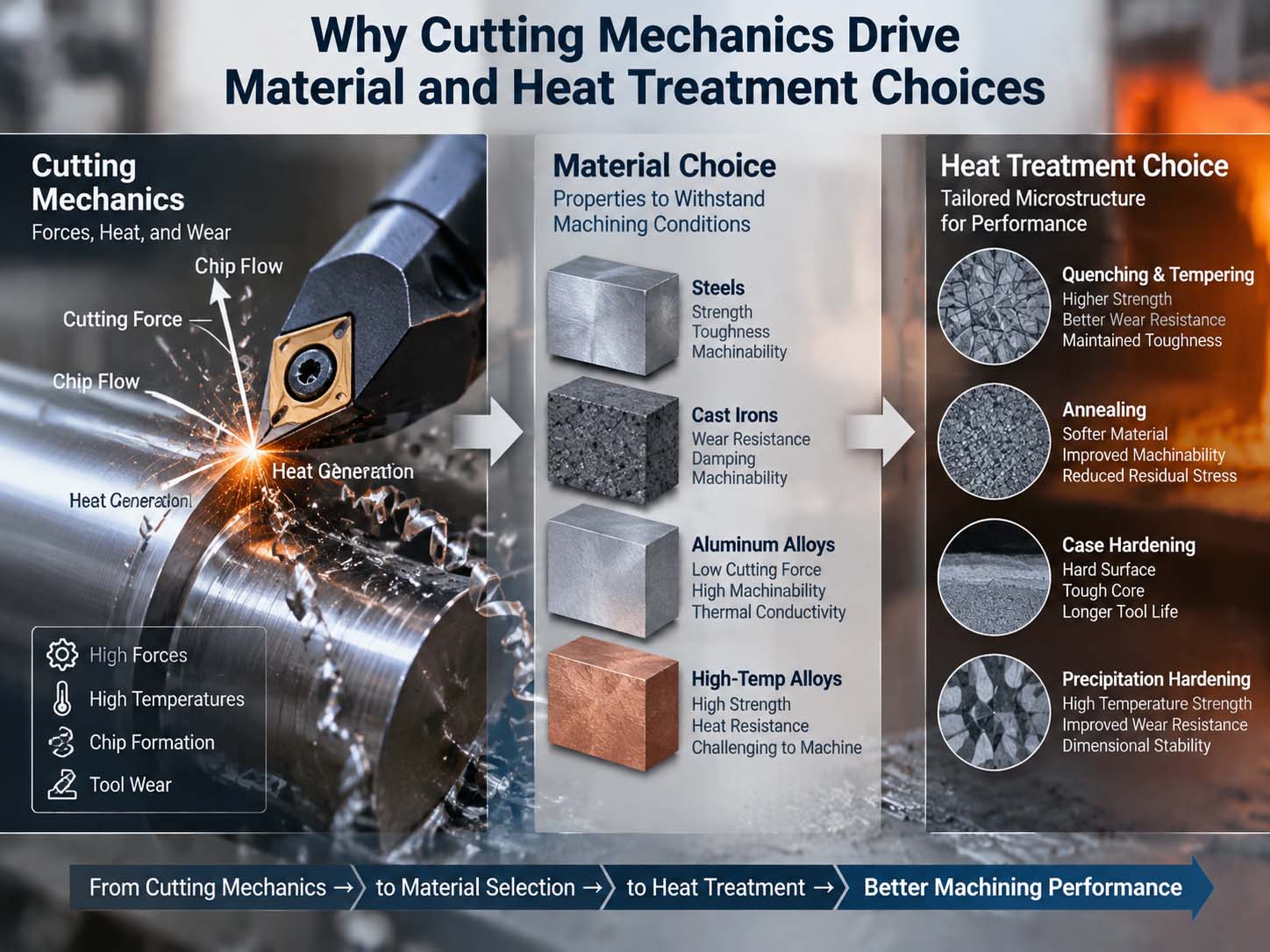
For lines processing mixed metal streams, the practical answer is usually a matched set rather than a single "best" grade - metal shredder blades and spacers selected for the same application so that wear rates, clearance, and load capacity stay balanced across the shaft.
Every mechanical mismatch eventually shows up in the energy bill. Friction converts drive power into heat instead of fracture. As edge temperature rises, the edge softens, which increases friction further - a loop that accelerates wear and shortens the usable edge life of an otherwise sound blade.
The measurable signals are consistent. Energy per ton processed rises because the drive is doing work that no longer separates material. Particle size distribution widens because part of the feed is sheared correctly while the rest is crushed. Fines increase. Vibration and noise increase. And because fines and oversize both need re-processing, the real cost appears downstream of the shredder, not at the blade.
This is the practical argument for treating geometry, clearance, and material as a system: the parameters that look like technical details are the same parameters that decide your cost per ton.
| Symptom | Likely mechanical cause | First check |
|---|---|---|
| Oversize pieces in the output | Clearance too wide; material drawn in instead of cut | Measure clearance at several points along the shaft |
| Excess fines and dust | Crushing instead of shearing; dull edge or excessive clearance | Inspect edge radius and cutting profile |
| Rising motor load per ton | Compression replacing shear; dull edge or clearance too tight | Compare edge radius and clearance against the last log |
| Chipping along the cutting edge | Impact beyond the blade's toughness; tramp metal | Review blade grade against feed and check for foreign material |
| Cracks radiating from the bore | Stress concentration, loose fit, or overload | Inspect bore accuracy, seating, and bolt torque |
| Uneven wear on one side | Shaft misalignment, uneven feed, incorrect installation | Check alignment and feed distribution |
| Frequent jams with high fines | Over-aggressive hook depth or incorrect gap | Review hook depth against the feed stream |
Cutting mechanics explain what operators see but rarely have time to analyze. A blade that seems to fail "for no reason" is usually the visible end of a chain that starts with a clearance that drifted, a geometry that never matched the feed, or a load path that concentrates stress where the design did not intend it.
The sequence that works is consistent: define the cutting action your feed requires, set and maintain clearance with knives and spacers treated as one set, then select material and heat treatment against the loads the application actually generates. Once the mechanism is understood, specification becomes concrete: shredder blades for metal recycling should be chosen against measured loads and feed characteristics rather than against a catalogue description. When performance still falls short, root-cause analysis is faster than another blade change - and it is the difference between maintaining a machine and managing a cutting system.
shredder blade durability maintenance strategies covers the inspection and replacement side of that system in detail. If your line is losing throughput and you cannot isolate whether the cause is geometry, clearance, or material, send us the machine details, your blade drawing or dimensions, and your feed description - Contact our engineering team to review the cutting system against your actual operating conditions.
Hardness improves resistance to abrasive wear, but it reduces the blade's ability to absorb impact. In impact-heavy metal shredding, the edge chips instead of gradually rounding, and every chip becomes a stress concentration point for the next load cycle. Service life depends on the balance between hardness and toughness for your specific feed.
Look at the output and the power draw together. Oversize pieces, burrs, and torn edges usually indicate clearance that is too wide. Heat, jams, and a steadily rising motor load usually indicate clearance that is too tight. Measure with a feeler gauge at several points and compare against your last reading rather than against a single nominal value.
Inspect them together and replace them together when either is out of tolerance. Worn or compressed spacers change the clearance that new knives sit at, so a new knife set installed on old spacers can reproduce the same damage pattern that retired the previous set.
Machine model and shaft arrangement, a blade drawing or measured dimensions, the material you process and its typical size, throughput and target output size, the blade grade currently in use if known, and a description of how the blades have been failing. Wear patterns and photos of failed edges are often more useful than the drawing alone.
Yes. Hook depth and tooth pitch control bite per revolution, and edge angle controls how much force is needed to penetrate. Changing the profile without changing anything else can shift throughput, particle size, and power draw simultaneously - which is why geometry changes should be made one step at a time.
メッセージをお残しください
ホーム
products
contact